
Don’t Just Cover White Hair—Open the Path
Can TCM Help Bring Back Your Black Hair?
Have you ever looked in the mirror, spotted a cluster of new white hairs, and thought, “Wait… when did that happen?” White hair has a sneaky way of making us look and feel older almost overnight. Many people start seeing white strands in their early 40s—sometimes even earlier—and no matter how often they pluck or dye them, they just keep coming back.
So a very natural question is:
Is white hair really impossible to reverse?
Or are we just stuck covering it up with hair dye again and again?
For a long time, I thought dyeing was the only realistic option—until I dove into the world of Traditional Chinese Medicine (TCM) and what I like to call the “Qi boost” approach. That’s when I realized something important: many people boost the wrong way, they’re just ignoring one key piece—the pathway.
In other words, it’s not that you’re not nourishing your body.
Is that what you’re “boosting” (like blood, Qi, and kidney essence) may never actually reach your scalp and hair follicles?
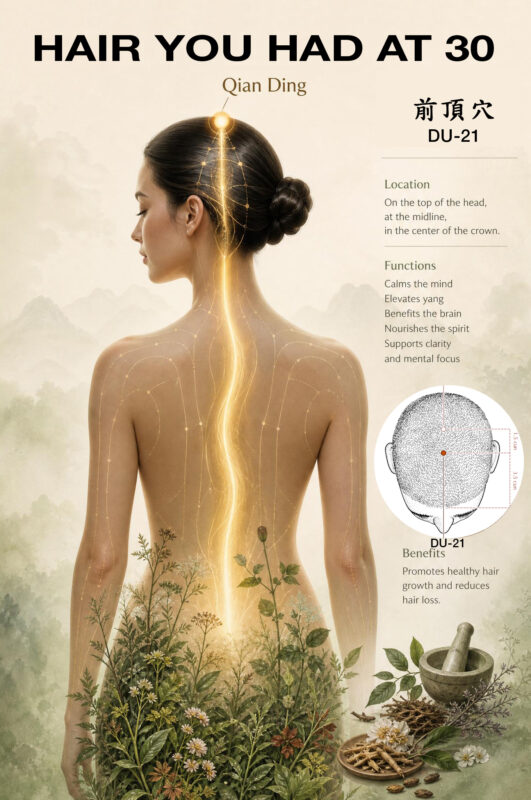
And the often-overlooked switch in this story sits right on top of your head: a point called Qian Ding (前顶穴).
Your Hair Is Not “Just Hair”
From a TCM perspective, your hair isn’t a separate, isolated part of your body. Its color, shine, and thickness are all reflections of what’s going on inside—your organs, your Qi and blood, and the state of your meridians.
In simplified TCM terms, healthy, dark, shiny hair depends mainly on three things:
- Sufficient kidney essence
- Abundant Qi and blood
- Smooth meridian circulation to the head and scalp
For many people, the white hairs that show up with age are linked to the gradual depletion of kidney essence. When kidney essence runs low, the brain and marrow don’t get enough nourishment, and your hair naturally becomes dry, brittle, and white more easily.
Then there’s another group: people who get white hair early—maybe in their 20s or 30s. Often, their issues are tied to chronic stress, lack of sleep, blood and Qi depletion, and overall weakness. On the surface, it looks like “just white hair,” but behind it, the same pattern shows up again and again: insufficient Qi and blood plus poor circulation to the head.
From a Qi-boosting TCM angle, that means one thing:
White hair is not just something to cover up. It’s a signal that the foundation that nourishes your hair needs to be rebuilt.
Why Just Food Isn’t Working
Here’s where many people get stuck.
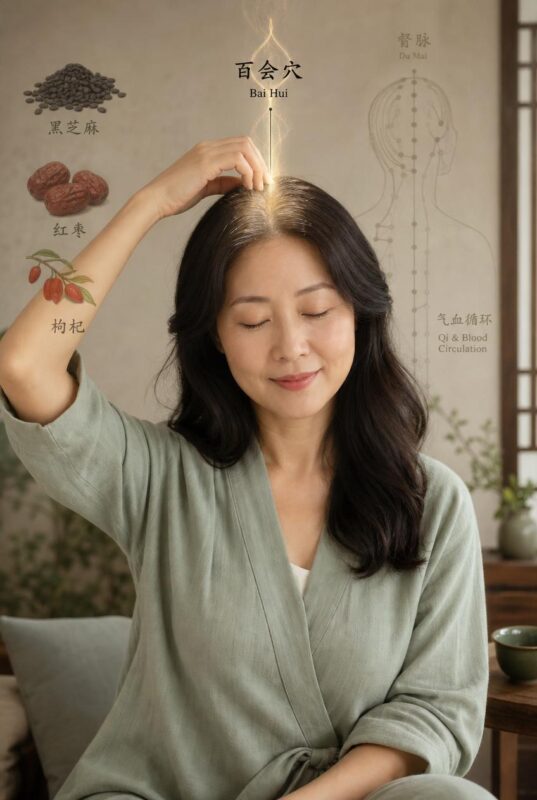
You might be faithfully eating black sesame for your kidneys, sipping red dates and goji berry tea for your blood, maybe even taking herbal formulas. None of that is wrong—in fact, those are classic TCM strategies.
But maybe, despite all that effort, your hair still keeps turning white. Why?
Think of your body as a water system.
The water source is strong, and the pressure is good—but if the faucet is turned off or the pipes are clogged, the water still won’t come out. Even if it does, it might just be a weak trickle.
Your body works the same way.
You can boost all the Qi, blood, and kidney essence you want, but if the pathway to your scalp isn’t open—and that “main switch” on top of your head isn’t activated—your hair follicles still won’t get what they need.
That’s why I often say:
Instead of blindly boosting more and more, start by opening the pathway.
And in this TCM Qi-boost approach, that “main switch” on the top of your head is exactly where the Qian Ding Acupresure point comes in.
Meet Qian Ding: The “Main Switch” on Your Head
Qian Ding (前顶穴) is a point located on the midline at the top of your head, along the Du Mai (Governing Vessel), just like the famous Bai Hui (百会). It doesn’t look like much from the outside, but its role is far from small.
In TCM, there’s a concept called Qi Jie (气街)—you can think of it as a major “highway” for Qi and blood flow. The head has its own Qi street, a key route where the body’s essence and Qi move upward and gather in the head.
Qian Ding is one of the important “hubs” along this route.
If we compare your body to a transportation system, Qian Ding is like a crucial interchange station. When this area is gently stimulated and opened, it helps Qi and blood move more smoothly upward, nourishing your scalp and hair follicles. It also interacts with circulation throughout the head and face.
So Qian Ding isn’t just about boosting more.
It helps complete the last mile of that journey—getting the nourishment all the way up to your scalp. When that final stretch opens up, all the nutrition you’ve been boosting finally has a chance to reach your hair follicles.
A Real Case: From White to Black Again
Let me share a real case that really made me look twice at Qian Ding.
There was a 77-year-old gentleman who was receiving ongoing acupuncture and moxibustion after a stroke. The main goal of his treatment was to help him recover movement, not to treat his white hair.
During his sessions, the doctor discovered a point on his head that was especially sensitive to warmth—Qian Ding. So each time, they used a moxa stick for gentle suspended moxibustion at this spot.
Every session, the gentleman felt a distinct warm flow spreading from the area, first outward around his scalp, then sinking inward toward his head, leaving him feeling deeply comfortable.
After about 10 sessions, something surprising happened:
People started noticing that hair near the top front of his head—especially along the midline—was turning black from the roots. It looked like two dark bands forming on his scalp. As the sessions continued, this darkening spread.
By around the 30th session, most of his previously white hair had turned nearly black, and the texture had become smoother and shinier. Even more interesting, over the next two years, his hair didn’t quickly revert to white.
Is this “magic”? Not really.
What it reminds us is this: Sometimes the problem isn’t whether you’re booting enough—it’s whether things are actually flowing.
How to Find Qian Ding on Your Own Head
Don’t worry, Qian Ding isn’t too hard to find.
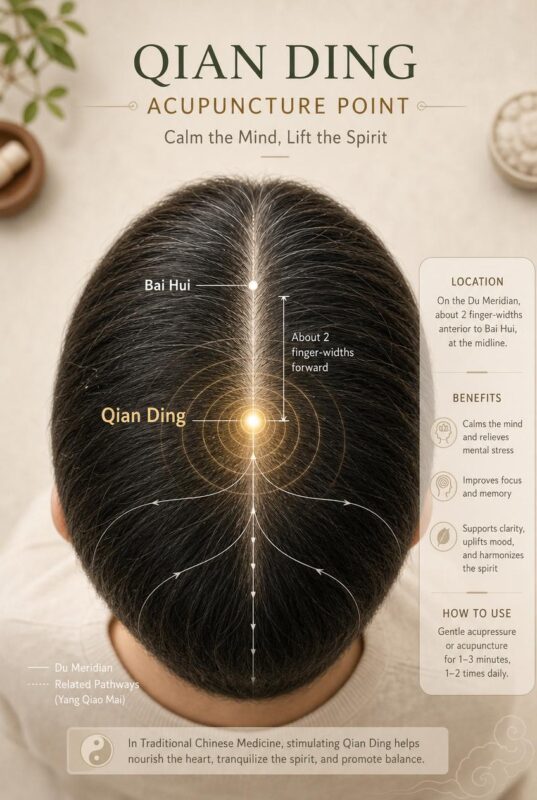
Most people know Bai Hui (百会).
To find Bai Hui, imagine lines going up from the tips of both ears; where they meet at the top center of your head is roughly Bai Hui.
From there:
- Move your fingers about 1.5 cun (roughly two finger-widths) forward along the midline.
- That spot is Qian Ding.
In simple terms:
It’s on the top midline of your head, just a little in front of Bai Hui.
If you can’t find it exactly the first time, don’t stress about precision. Gently explore that general area with soft pressing or rubbing—often, you’ll notice a spot that feels more sensitive, sore, or “noticeable” when you touch it. That’s likely your Qian Ding.
Why Stimulating Qian Ding Matters
From a Qi-boosting TCM point of view, stimulating Qian Ding serves two main purposes:
- Helping Yang Qi rise and flow smoothly
- Du Mai, also called the “Sea of Yang Meridians,” is closely tied to the movement of Yang Qi throughout the body. The top of the head is an important gathering point for Yang Qi. When Du Mai is open and flowing, Qi and blood can reach the head more efficiently.
- Opening the “gateway” for nourishment to reach the scalp
- Qian Ding acts like a key checkpoint for Qi and blood traveling to the head. With consistent, gentle stimulation, it helps the twelve meridians and Du Mai establish smoother connections to the head. Put simply, you’re giving nutrients a clear road to your hair follicles so they can finally be properly nourished.
That’s why I really like using this TCM Qi boost framework to understand white hair. It doesn’t just stare at the hair itself—it looks at whether the whole delivery system behind your hair is actually working.
Two Simple Ways to Work with Qian Ding
There are many ways to work with this point, but I especially like two options that are simple, safe, and practical for daily life.
- Gentle moxibustion
- Finger massage (pressing and rubbing with your hands)
You don’t need complex tools or professional skills to start. Just choose whichever method feels more realistic and comfortable for your lifestyle.
Option 1: Gentle Moxibustion (For Those Who Don’t Mind the Smell)
If you’re not afraid of a little effort and don’t mind the smell of moxa—or if you have someone at home who can help—gentle moxibustion can be a good choice.
The key is not “the hotter, the better.”
Many people make the mistake of thinking maximum heat means maximum effect, but TCM views it differently.
What you actually want is:
- A warm, soft, penetrating sensation
- Heat that feels like it’s slowly soaking inward, not just burning the surface of your scalp
That gently penetrating warmth aligns with TCM’s concept of “warmly unblocking,” which is at the heart of this Qi-boosting approach.
Option 2: Finger Massage (My Favorite Everyday Method)
If moxibustion feels inconvenient, or you don’t like smoke at home, I highly recommend using your fingers to massage Qian Ding.
This method is:
- Simple
- Safe
- Easy to do anytime, almost anywhere
- Completely self-operated—you don’t need anyone else’s help.
How to Do It
Here’s a straightforward way to try:
- Sit or stand comfortably and relax your shoulders.
- Find the Qian Ding area (as described above).
- Use the pads of your index or middle fingers, or even the small knuckles, to gently press and rub the point.
- Use steady, moderate pressure—firm enough to feel, but not so strong that it hurts.
- Maintain a slow, rhythmic motion—either small circles or gentle pressing and releasing.
What to Focus On
As you work the point, imagine your fingers as a gentle, invisible flame, guiding warmth and Qi into the area. Use both your intention and your touch to invite circulation upward.
Don’t underestimate how powerful something this simple can be.
As long as you do it consistently, many people find this method easier to stick with long-term than more complicated health routines. And in the end, the most effective wellness methods are rarely the fanciest—they’re the ones you actually do every day.
Who Can Benefit from Qian Ding Work?
This isn’t just for older people with a full head of white hair. In fact, a few types of people may particularly benefit:
- Those with age-related white hair
- People with early-onset white hair from stress, poor sleep, or an irregular lifestyle
- Anyone with an oily scalp, fatigue, or signs of Qi and blood depletion
After massaging Qian Ding daily for a little over a month, they noticed less scalp oil, more stable energy, and some new, shorter hairs growing in darker.
Of course, everyone’s body is different.
Some people notice changes quickly; others may need more time. The key is that if your direction is right and you stay consistent, your body often responds in its own quiet, gradual way.
Don’t Just Cover White Hair—Open the Path
With white hair, a common trap is to rush into boasting mode.
Today, you hear black sesame is good, so you eat it every day.
Tomorrow, someone mentions goji berries and red dates, so you steep them in every cup of tea. Again, boost itself isn’t wrong—but if the pathway to your scalp remains blocked, the overall effect will always be limited.
So I’d invite you to slightly shift your mindset:
Instead of thinking,
“What else can I eat?”
Ask yourself,
“Is the pathway open for what I’ve already replenish to reach my head?”
Open the “main switch” on top of your head first.
Once Qi and blood can flow upward smoothly, your other efforts to nourish your body are much more likely to show up in your hair.
Qian Ding is worth paying attention to for exactly this reason. It’s not just a random scalp-massage point; from a TCM Qi-boosting perspective, it’s a key hub that helps Qi and blood reach the head.
If white hair has been bothering you, consider Qian Ding a new starting point. Maybe what you’ve been missing isn’t another supplement—but a bit of gentle “unblocking.”
Start Small, But Start
Body changes rarely happen overnight.
They often begin with little things:
- Your scalp feels less oily.
- You wake up feeling a bit more refreshed.
- New baby hairs appear, and their color seems slightly deeper.
These may seem like small details, but they’re often signs that your body is moving in a better direction.
If you’re using finger massage, aim for 10–15 minutes each time. If you’re using gentle moxibustion, around 15–20 minutes is usually enough. The focus isn’t on doing a marathon session once in a while—it’s about doing a modest amount consistently.
You don’t need to turn this into yet another stressful “project” in your life.
Simply think of it as a few quiet minutes each day where you reconnect with your body—and give your scalp, your Qi, and your hair a little extra care.
Who knows? Over time, your mirror might start giving you some pleasantly surprising feedback.